Osage oil wealth and prosperity
Killers of the Flower MoonOsage oil wealth and prosperity transformed mineral rights beneath a reservation once dismissed as barren into a source of immense collective income. By 1923, the Osage had become the wealthiest people per capita in the world. Yet the flow of money unfolded within a history of dispossession and under rules that limited many Osage people’s ability to control their own funds. The resulting contrast—between vast revenues and restricted authority—made prosperity both a material achievement and a point of vulnerability.
From dispossession to mineral rights
The wealth originated in a landscape whose value had been radically misjudged. After the Osage were driven from their lands in Kansas, they eventually found refuge on rocky territory in what became Oklahoma. Earlier forced cessions had cost them nearly a hundred million acres; in 1870, the Osage agreed to sell their Kansas lands to settlers for $1.25 an acre after being expelled from their lodges and seeing their graves plundered. The territory they later occupied was widely regarded by white observers as broken and unsuitable for farming. Beneath it, however, lay extensive oil deposits.
When allotment threatened to divide the reservation into individual parcels and open the remainder to settlers, George Bigheart and John Palmer negotiated a different arrangement. The Osage secured allotments distributed only among tribal members, increasing each person’s share from the proposed 160 acres to 657 acres. Crucially, the 1906 agreement reserved the oil, gas, coal, and other minerals to the Osage Tribe. That provision protected a collective resource even as allotment divided surface land. The distinction between what could be seen and settled and the mineral wealth below it became the foundation of the later income.
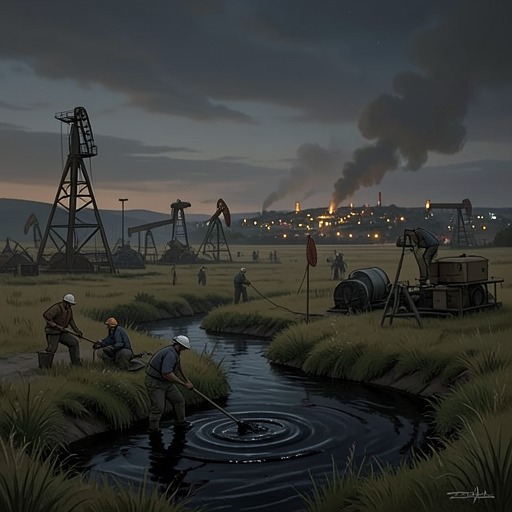
Oil had begun to be found before the full scale of the resource was apparent. An Osage man showed John Florer, a trading-post owner in Gray Horse, an oily sheen on a creek; the substance was identified as oil, and Florer and a banking partner obtained a drilling lease with the tribe’s approval. A more spectacular phase arrived in 1917. On Lot 185, near Lot 50, a derrick shuddered, the ground erupted, and a black column of oil burst into the air. Such gushers turned underground reserves into visible spectacle. Osage spectators watched oil rise as much as a hundred feet above the rigs; although the spray coated flowers, fields, workers, and onlookers, people celebrated, hugging and tossing their hats.
How oil became collective income
The reservation’s oil revenues reached members through their place on the Osage Roll. Each registered member received a quarterly payment. The checks began at only a few dollars, but as production expanded, dividends grew to hundreds and then thousands, increasing as new oil was tapped. In 1923 alone, the Osage took in more than $30 million, valued by the book at over $400 million in contemporary terms. The income accumulated across the tribe into millions, making the Osage a striking exception to prevailing assumptions about Indigenous poverty.
Oil leases connected that collective mineral resource to a growing commercial rush. Beginning in 1912, auctions overseen by the United States Department of the Interior offered portions of the underground reservation for drilling. They were held about four times a year, and a typical lease covered 160 acres. Competition drove bids and auction totals sharply upward: a single lease sold for nearly $2 million, while one auction collected nearly $14 million. The auctions drew oilmen and spectators to Pawhuska, capital of the Osage Nation, including Osage people and prominent local settlers. The money circulating through the oil economy helped build local businesses, even as its benefits and control were unevenly distributed.
Public fascination and racialized judgment
The public response made Osage affluence a national spectacle. Newspapers and magazines described wealthy Osage through images of mansions, chandeliers, diamonds, fur coats, and chauffeured cars; reports also emphasized traditional ceremonies and clothing, presenting the juxtaposition of modern luxury and Osage cultural life as a curiosity. Stories of Osage arriving at a dance by private airplane or gathering around an open campfire fed an audience’s appetite for apparent contradiction. The coverage did not simply record prosperity: it framed Osage people through stereotypes, turning their wealth into evidence to be marveled at, mocked, or questioned.
That framing had practical consequences. As oil revenues rose, white critics increasingly portrayed Osage wealth as proof that the Osage were wasteful and required outside control. The claim that something had to be done about their prosperity helped legitimize restrictions rather than recognize the Osage’s right to use income generated by their own mineral estate. The book’s account sets this rhetoric against the land history that made the wealth possible: the territory had been treated as worthless when the Osage were pushed onto it, but its value became a source of scrutiny once oil made the Osage rich.
Guardianship, restrictions, and extraction
Federal administration placed another barrier between many Osage people and their money. The Office of Indian Affairs classified some members, including Anna Brown and Lizzie, as incompetent and required white guardians to oversee their spending, even down to ordinary purchases. These appointments were commonly determined by blood quantum: full-blooded Osage were routinely assigned guardians, while mixed-blood people rarely were. The system thus made racial classification a means of controlling access to property, despite protests that Osage members should not be judged by the amount of Indigenous or white ancestry in their blood.
In 1921, Congress imposed additional limits on people with guardians. They were also designated restricted and could withdraw only a few thousand dollars a year from their trust funds, even when they needed money for schooling or a sick child’s hospital care. Mollie Burkhart, a full-blooded Osage woman, was among those whose funds were restricted; her husband, Ernest Burkhart, was her guardian. The arrangement exposed a sharp contradiction: members received income from the Osage mineral estate, yet federal policy could restrict their access to it and place decisions in the hands of local guardians.
The money also attracted private exploitation. Scott Mathis, owner of the Big Hill Trading Company, administered the estates of Anna Brown and Lizzie. More broadly, investigators found guardians who bought goods for their wards from their own businesses at inflated prices, directed business to favored stores in return for kickbacks, claimed to purchase property for wards while acquiring it for themselves, or simply stole. One government study estimated that before 1925 guardians had taken at least $8 million directly from restricted Osage accounts. The scale of this abuse turned the promise of protection into a channel for stripping wealth from people already denied full control of it.
Prosperity and its cost
Oil income did not erase the conditions that preceded it. The Osage had preserved mineral rights through negotiation after forced removals and repeated land losses; the revenues that followed were therefore not an accidental windfall detached from history, but proceeds from a resource the tribe had deliberately retained. At the same time, allotment, guardianship, spending restrictions, and local profiteering limited the practical power that income might otherwise have afforded. Wealth drew oilmen, merchants, officials, and would-be exploiters into the community, while public stereotypes helped recast the people whose resources generated the boom as unfit to manage them.
The book presents this prosperity as both achievement and exposure. The preserved mineral estate produced extraordinary revenue, and the quarterly payments made that wealth visible across the country. But visibility brought scrutiny, and a system that celebrated oil production could still deny many Osage people authority over their own money. The central tension is not simply that a rich community faced greed; it is that the legal and administrative structures surrounding its wealth repeatedly placed control in other hands.